Is Bhang Goli Legal in India? State-Wise Guide 2026
If you have searched for “Is Bhang Goli legal in India?”, the answer is more complicated than a simple yes or no.
The legal position depends on what the product contains, which part of the cannabis plant is used, the applicable central law, and the laws and licensing rules of the particular state.
Under the Narcotic Drugs and Psychotropic Substances Act, 1985 (NDPS Act), the statutory definition of cannabis includes charas and ganja but excludes cannabis seeds and leaves when they are not accompanied by the flowering or fruiting tops. The Government of India’s Department of Revenue has also explained that bhang made from cannabis leaves is not covered by the NDPS Act when it does not contain cannabis resin or flowering tops.
However, this does not mean that every bhang product is automatically legal everywhere in India. State governments can regulate the manufacture, possession, sale, distribution, licensing, and other aspects of bhang under their own laws.
This 2026 guide explains the central legal framework, why state law matters, how bhang differs from ganja and charas, and what consumers should check before purchasing a bhang product.
Important: This article is for general educational information and is not legal advice. Laws, regulations, licensing requirements, court decisions, and enforcement practices can change. Always verify the current rules applicable to your state and the specific product.
What Does the NDPS Act Say About Bhang?
The Narcotic Drugs and Psychotropic Substances Act, 1985 is India’s principal central legislation dealing with narcotic drugs and psychotropic substances.
Section 2(iii) defines “cannabis (hemp)” to include:
- Charas — separated cannabis resin, including preparations commonly known as hashish oil or liquid hashish.
- Ganja — the flowering or fruiting tops of the cannabis plant, excluding seeds and leaves when they are not accompanied by the tops.
- Certain mixtures or drinks prepared from the forms of cannabis covered by the definition.
The statutory wording is important because it distinguishes the flowering or fruiting tops from cannabis leaves and seeds.
You can read the Narcotic Drugs and Psychotropic Substances Act, 1985 on India Code for the official statutory text.
Does the NDPS Act Ban Bhang?
Not automatically.
The Government of India’s Department of Revenue has stated in its national policy that bhang prepared from cannabis leaves is not covered by the NDPS Act when it is not made from cannabis resin or flowering tops. The same policy explains that production and sale of bhang are permitted by many state governments, subject to state regulation and licensing.
This distinction is one reason the legal status of bhang is different from the legal treatment of ganja and charas.
However, the phrase “not covered by the NDPS Act” should not be interpreted as “legal everywhere.”
State legislation can impose additional restrictions.
Readers can verify this directly in the Official NDPS Act PDF.
Why State Law Matters
Section 10 of the NDPS Act gives state governments powers to permit and regulate certain activities involving narcotic drugs and cannabis-related matters within the framework of the Act.
As a result, the legal position of bhang can vary between states.
A state may:
- Permit regulated sale through licensed outlets
- Require an excise licence
- Restrict manufacture or distribution
- Impose conditions on products or sellers
- Prohibit bhang altogether
- Apply different rules to different forms of bhang
- Change its rules through notifications, policies, or amendments
Therefore, knowing only what the central NDPS Act says is not enough to determine whether a particular bhang product can legally be purchased, possessed, sold, or transported in a particular state.
Bhang vs Ganja vs Charas
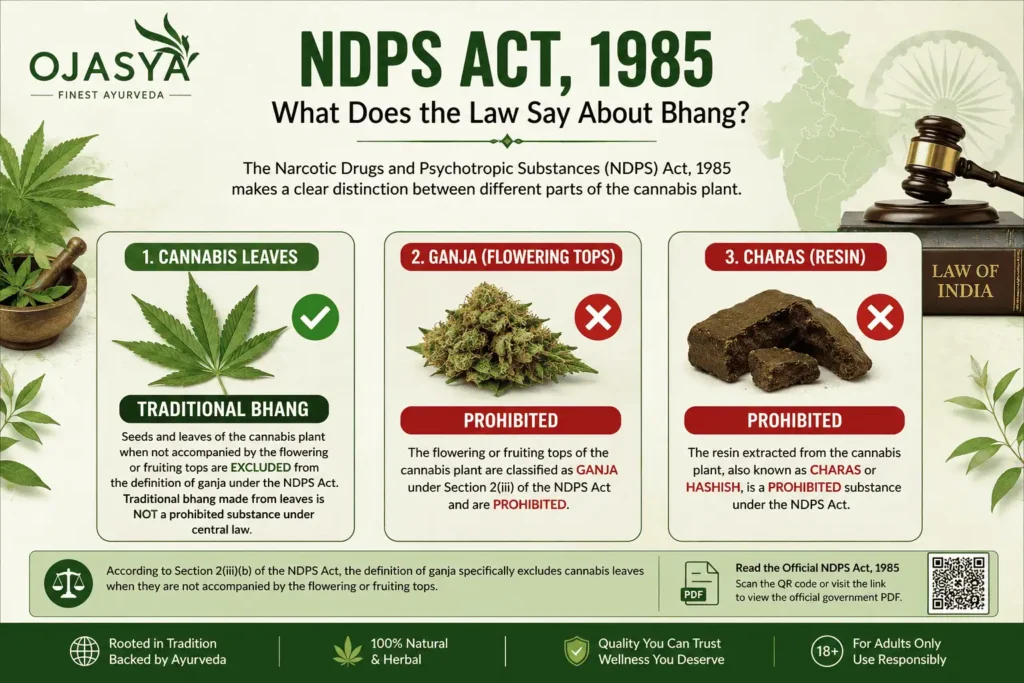
One of the biggest sources of confusion is treating bhang, ganja, and charas as legally identical.
They are not necessarily treated the same way under Indian law.
Ganja
Under the NDPS Act, ganja refers to the flowering or fruiting tops of the cannabis plant, excluding seeds and leaves when they are not accompanied by the tops.
Ganja is therefore covered by the NDPS Act’s cannabis provisions.
Charas
Charas refers to cannabis resin, including concentrated preparations of the resin. It is also included within the NDPS Act’s definition of cannabis.
Bhang
Traditional bhang is generally associated with preparations made from cannabis leaves.
Where a preparation consists only of material that falls outside the NDPS definition of cannabis, the central NDPS position can be different from that applicable to ganja or charas. The Department of Revenue specifically recognizes this distinction for leaf-based bhang.
But the actual ingredients of a commercial product matter. A product marketed as “bhang” should not be assumed to be legally equivalent to every other bhang preparation.
What About Bhang Goli?
Bhang goli is a product format associated with traditional bhang preparations.
The legal question is not determined simply by the words “bhang goli” printed on a package.
Important factors can include:
- Ingredients used in the product
- Whether cannabis leaves are used
- Whether flowering or fruiting tops are present
- Whether cannabis resin is present
- Applicable central law
- Applicable state law
- Licensing requirements
- Rules concerning sale and distribution
- The location of the seller and buyer
- Transportation requirements
This is why a product should be evaluated based on its actual composition and the applicable law rather than its product name alone.
State-Wise Bhang Laws in India
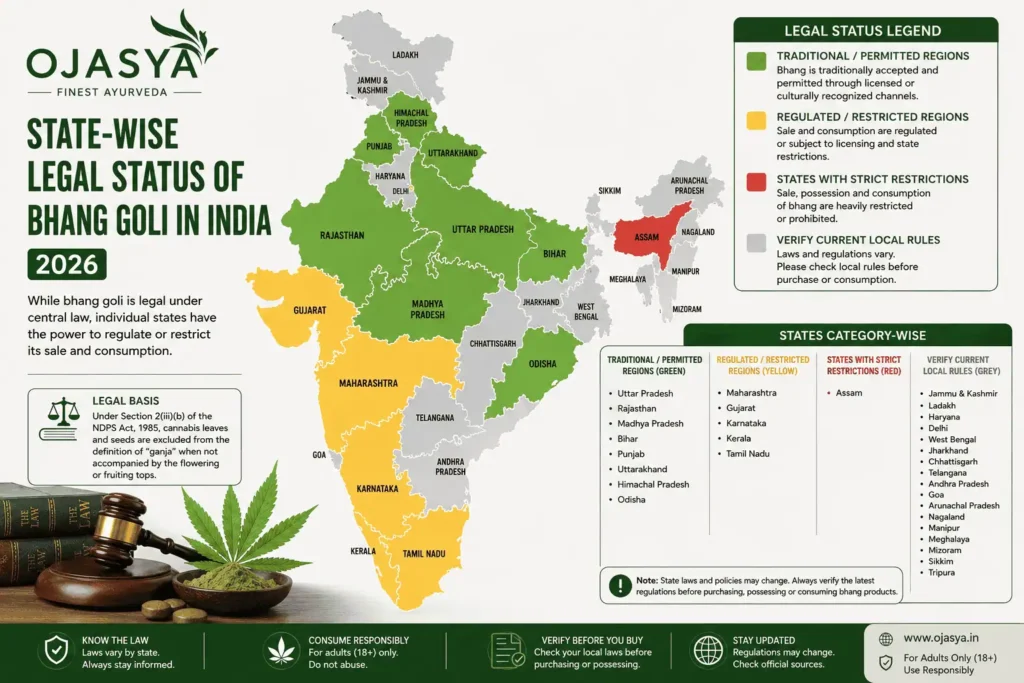
There is no single nationwide rule saying that every form of bhang is either legal or illegal in every state.
State regulations can be very different.
The following examples demonstrate why consumers should check state-specific rules rather than relying on a general statement about India.
Rajasthan
Rajasthan provides a clear example of state-level regulation of bhang.
The Rajasthan Excise Department publishes information concerning licensing for bhang. Its official material describes licensed wholesale and retail arrangements for bhang and explains how bhang can be procured and supplied through the regulated system.
This means the relevant question in Rajasthan is not simply whether bhang exists legally, but whether the particular activity and product comply with the applicable licensing and excise requirements.
For current state rules, consumers should consult the Rajasthan Excise Department rather than relying on an old online list.
Madhya Pradesh
Madhya Pradesh also demonstrates that bhang can be subject to an excise and licensing framework.
The Madhya Pradesh government has published excise provisions dealing with bhang, and its official procurement system shows a government Excise Department tender for supplying Thok Bhang for 2026–27.
This is evidence that bhang is regulated within a state framework rather than simply being treated as an unrestricted product.
Uttarakhand
Uttarakhand’s Excise Department maintains a dedicated “Related to Bhang Manual”, showing that bhang is addressed within the state’s excise administration.
The state has also published excise-related material referring specifically to bhang and applicable duties.
Again, this demonstrates why consumers should check the current state framework rather than assuming that the central NDPS position alone answers every question.
Assam
Assam requires particular caution.
The Government of Assam publishes the Assam Ganja and Bhang Prohibition Act, 1959, demonstrating that Assam has specific legislation dealing with both ganja and bhang.
Therefore, a general statement that “bhang is legal in India because leaves are excluded from the NDPS Act” would be misleading for someone in Assam.
Uttar Pradesh
Uttar Pradesh has a long association with regulated bhang traditions, but consumers should still distinguish between traditional cultural availability and the legal requirements applicable to a particular sale or product.
State rules, licensing arrangements, and local requirements can change. Buyers should therefore verify the current position before purchasing or possessing a packaged bhang product.
Other States and Union Territories
For states such as Bihar, Maharashtra, Karnataka, Kerala, Punjab, Odisha, Tamil Nadu, Gujarat, Himachal Pradesh, and others, the legal position should not be reduced to a simple “legal” or “illegal” label without checking the relevant current state legislation, excise rules, notifications, and licensing requirements.
This is particularly important for online purchases, because the rules applicable to sale, dispatch, transportation, and possession can involve more than one jurisdiction.
For official state legislation and notifications, the Supreme Court’s e-Committee notes that state enactments, statutory rules, notifications, circulars, and orders are available through official state-law resources.
Is Bhang Goli Legal in Bihar?
There is no single answer that can safely be given merely from the NDPS Act.
The central NDPS framework does not automatically treat leaf-only bhang in the same way as ganja or charas, but Bihar’s state-level rules and the actual composition of the product must also be considered.
Therefore, someone purchasing or possessing a packaged bhang goli in Bihar should verify the current applicable state rules and the product’s ingredients rather than relying only on the general NDPS distinction.
Is Bhang Goli Legal in Uttar Pradesh?
Uttar Pradesh has a well-established history of regulated bhang traditions.
However, legality depends on the applicable state rules, licensing arrangements, and the specific product involved.
A consumer should not interpret the existence of licensed bhang sales as permission for every type of cannabis-related product or every method of sale.
Is Bhang Goli Legal in Rajasthan?
Rajasthan has an established state licensing framework for bhang.
The Rajasthan Excise Department specifically publishes licensing information for bhang and describes regulated wholesale and retail arrangements.
Therefore, the legality of a particular purchase should be considered in the context of the applicable licensing and excise rules.
Is Bhang Goli Legal in Madhya Pradesh?
Madhya Pradesh regulates bhang through its excise framework. Official state material includes provisions relating to bhang, and the state Excise Department has current procurement activity for bhang for the 2026–27 year.
This does not mean every bhang product or every method of sale is automatically permitted. The applicable licence, product, seller, and transaction should be considered.
Is Bhang Goli Legal in Assam?
Assam requires particular caution because the state has specific legislation titled the Assam Ganja and Bhang Prohibition Act, 1959.
Consumers in Assam should therefore check the current state law before purchasing, possessing, or transporting a bhang product.
Can You Buy Bhang Goli Online in India?
This is one of the most important questions for consumers.
The fact that a product is listed on an online store does not itself establish that the sale is legal in every state.
Before purchasing a bhang product online, consumers should check:
- The product ingredients
- The seller’s identity and compliance information
- Whether the product contains flowering or fruiting cannabis tops
- Whether cannabis resin is present
- The rules in the buyer’s state
- Any applicable licensing requirements
- Rules concerning transportation or delivery
- Current government notifications or state excise rules
This is particularly important because state laws can differ.
If you are researching traditional products, you can explore the Ojasya Bhang Products collection, but product availability on a website should not be treated as a legal determination for your location.
Why Is Bhang Legality So Confusing?
There are several reasons people receive conflicting answers when searching for the legal status of bhang.
1. The NDPS definition is specific
The NDPS Act does not simply define every part of the cannabis plant as “cannabis” for the purpose of its definition. The treatment of leaves and seeds when not accompanied by flowering or fruiting tops is important.
2. State governments can regulate bhang
The central framework does not eliminate state-level regulation.
3. Products can have different compositions
Two products sold under similar names may not necessarily contain identical ingredients.
4. Old information remains online
State laws and administrative rules can change, while older articles may continue appearing in search results.
5. Online availability creates confusion
A product being available for purchase online does not necessarily mean that it can legally be sold, transported, or possessed everywhere.
What Should Consumers Check Before Buying Bhang Goli?
If you are considering a packaged product, review the product information carefully.
Look for:
- Full product name
- Ingredient information
- Manufacturer or seller information
- Product packaging
- Batch details
- Applicable warnings
- Storage information
- Any licence or regulatory information provided
- Applicable state requirements
Consumers should also verify the law applicable to their own location.
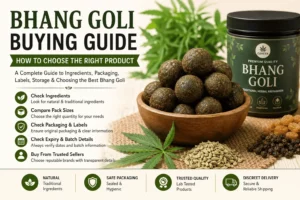
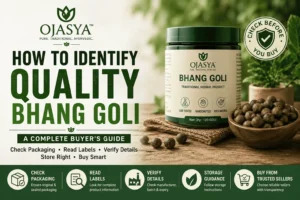
For information about evaluating product labels and packaging, see our Quality Bhang Goli Guide.
Bhang Legal Status: The Key Difference
The most important point to remember is this:
The fact that leaf-based bhang is generally outside the NDPS Act’s definition of cannabis does not mean that every bhang product is legal everywhere in India.
The actual product composition and the applicable state law both matter.
This distinction is especially important for packaged products such as bhang goli and bhang powder.
Frequently Asked Questions
Is Bhang Goli Legal in India?
There is no single answer for every product and every state. Leaf-based bhang can fall outside the NDPS Act’s definition of cannabis when it does not contain the prohibited cannabis forms covered by the Act, but state laws can impose additional restrictions.
Is Bhang Covered Under the NDPS Act?
Bhang made from cannabis leaves, without cannabis resin or flowering tops, is generally treated differently from ganja and charas under the central NDPS framework. The Government of India’s Department of Revenue specifically describes leaf-based bhang as not covered by the NDPS Act.
Is Ganja the Same as Bhang?
No. Under the NDPS Act, ganja refers to the flowering or fruiting tops of the cannabis plant, subject to the statutory definition. Traditional leaf-based bhang is treated differently under the central framework.
Is Charas the Same as Bhang?
No. Charas refers to cannabis resin, while traditional bhang is generally associated with cannabis leaves.
Can I Buy Bhang Goli Online?
Online availability does not by itself establish legality. Consumers should check the product’s ingredients and the current laws and licensing requirements applicable to their location before ordering.
Is Bhang Legal in Every Indian State?
No. State governments can regulate bhang differently. For example, Rajasthan has a bhang licensing framework, Madhya Pradesh has excise regulation and current government procurement activity, Uttarakhand has a dedicated bhang-related excise manual, and Assam has specific legislation prohibiting ganja and bhang.
Does State Law Matter for Bhang Goli?
Yes. State law can be particularly important for manufacture, sale, distribution, possession, licensing, and transportation.
Related Ojasya Guides
For more information, explore these related resources:
- Traditional Bhang in India: Culture, History & Heritage
- History of Bhang in India
- Traditional Bhang Products in India
- What Is Bhang Goli?
- Bhang Goli vs Bhang Powder
- Quality Bhang Goli Guide
- How to Store Bhang Goli
Explore Bhang Products
Readers interested in learning about packaged traditional products can visit the Ojasya Bhang Products collection.
You can also explore:
Product availability should not be interpreted as confirmation that a product is legal to purchase or possess in every location. Always verify the applicable local requirements.
Conclusion
So, is bhang goli legal in India?
The answer depends on more than the product name.
The NDPS Act distinguishes between cannabis resin, flowering or fruiting tops, and cannabis leaves and seeds when they are not accompanied by the tops. Government policy recognizes that leaf-based bhang is generally outside the NDPS Act’s definition of cannabis.
However, state-level laws and licensing requirements can still apply. Rajasthan, Madhya Pradesh, Uttarakhand, and Assam demonstrate how different state frameworks can be.
Therefore, anyone considering purchasing, possessing, selling, or transporting a bhang product should check:
- The exact product ingredients
- The applicable central law
- The law in their state
- Current state notifications and licensing requirements
- Any rules governing sale and transportation
The safest approach is to rely on current official legal sources rather than assuming that a general statement about bhang applies throughout India.
Disclaimer
This article is provided for general educational and informational purposes only and does not constitute legal advice. Laws, regulations, government notifications, court decisions, and interpretations may change over time and can vary between states. Ojasya does not guarantee that any particular bhang product is legal to purchase, possess, sell, or transport in a particular location. Readers should independently verify the current legal requirements applicable to their state and the specific product before taking any action.